
Why crypto’s obsession with transparency is giving way to programmable privacy — and what that unlocks
Something fundamental is shifting in how the blockchain industry thinks about transparency — and it’s forcing long-held assumptions back onto the table.
That shift is playing out in real time, and in this episode of Blockchain Banter, I sat down with Brad (Biz Dev at COTI), Primal Glenn (Biz Dev at Bancor), and Dr. Mark Richardson (Project Lead at Bancor) to unpack why privacy has moved from a secondary concern to a structural requirement — and why the next phase of the industry isn’t a binary choice between privacy and transparency, but something far more precise: selective, composable, programmable privacy.
https://medium.com/media/840b35198fd75473e6b288a9b3aec44a/href
The result wasn’t a single pro-privacy argument, but a clearer picture of where the industry actually is:
- Transparency helped establish trust — but it isn’t compatible with institutions, compliance, or regulated markets.
- Privacy doesn’t mean secrecy. It means selective disclosure, discretion, and protection.
- Not all privacy technologies are equal — and some are being pushed beyond what they’re built for.
- The next phase isn’t privacy versus transparency, but systems designed to support both.
The Narrative Flip: From “Everything Public” to “Some Things Must Be Private”
Brad pointed to a moment that made the shift impossible to ignore: EthCC, where privacy dominated the conversation.
The reason wasn’t ideological. It was practical.
Transparency works when participation is opt-in, crypto-native, and culturally aligned with openness. But once blockchains aim for broader adoption, that assumption breaks down quickly:
- Enterprises handle confidential consumer data
- Institutions operate under legal and fiduciary constraints
- Entire sectors are governed by privacy requirements, not preference
https://medium.com/media/dd51362aff5c69026f0da898a5cbbe7b/href
Brad put it bluntly: If an institution processes confidential data on a fully public blockchain, it can immediately collide with regulations like GDPR — including the right to revoke access to personal data.
At that point, it’s no longer a debate about values. It’s an operational dead end.
https://medium.com/media/07aaf9f2aba33d1eb03775d9abbf2eee/href
That reality is forcing the industry to grow up. Privacy is no longer an “advanced feature.” It’s starting to look like the cost of entry for the next wave of participants.
The Real Pivot: Composable Privacy, Not Total Darkness
The natural question followed: does privacy replace transparency entirely?
Brad reframed the issue with a distinction that shaped the rest of the discussion:
Composable privacy isn’t a black box.
It’s the ability to choose — deliberately — what stays public and what stays private, at the level of developers, users, and institutions.
https://medium.com/media/a2dbec9761ff410c968560d868f83748/href
That distinction matters because absolute privacy often produces environments that look familiar in the wrong ways:
- fenced-off perimeters
- KYC-only access
- limited interoperability
- visibility replaced by “trust the operator”
Composable privacy aims for the opposite:
- keep what benefits from transparency public
- shield what requires discretion
- preserve verifiability without exposing everything
This is where the conversation stopped being “privacy versus transparency” and became something more mature:
The future likely isn’t total visibility or total secrecy — it’s optional visibility, enforced by design.
Why Privacy Is Surging Now: The Technology Finally Caught Up (Sort of)
Glenn highlighted a quieter factor behind the shift: timing.
Privacy interest isn’t only ideological. It’s technical.
Verification systems are faster.
Computation over protected data is viable.
What lived in whitepapers is now deployable.
As a result, the ecosystem is experimenting across multiple approaches:
- privacy-native chains
- privacy layers integrating with existing networks
- SDK-based solutions requiring rewritten logic
- new computation models operating over encrypted or “garbled circuits”
That last category is where the call zoomed in.
Mark’s Provocation: The Industry Over-Fixated on ZK
Mark voiced something I suspect many builders think but rarely say out loud:
Zero-knowledge proofs have been treated as the answer for years — yet still struggle to deliver scalable, flexible privacy for complex use cases.
His critique wasn’t dismissive. It was realistic.
ZK is powerful, but it remains a developing science: heavy R&D, complex proving pipelines, and an unclear timeline to frictionless adoption.
https://medium.com/media/454cd6f66effabc5eb6f33f278da2ed6/href
That skepticism is what led him to COTI’s approach — and to a question that stuck with him:
Why hasn’t the industry been talking about Coti’s Garbled Circuits sooner?
Garbled Circuits: A “Finished” Privacy Primitive, Modernized for 2025
Mark framed garbled circuits as an idea ahead of its time.
The concept has been around for decades. The early critique wasn’t that it didn’t work — it was that its memory footprint and computational overhead were impractical in earlier eras.
But it’s 2025.

Memory isn’t scarce the way it once was, and modern infrastructure can support what previously felt too heavy.
https://medium.com/media/dd51362aff5c69026f0da898a5cbbe7b/href
Mark’s takeaway was blunt:
Sometimes building the “better mousetrap” is the wrong move. Sometimes the smarter move is resurrecting a mature concept that became viable only when the world caught up.
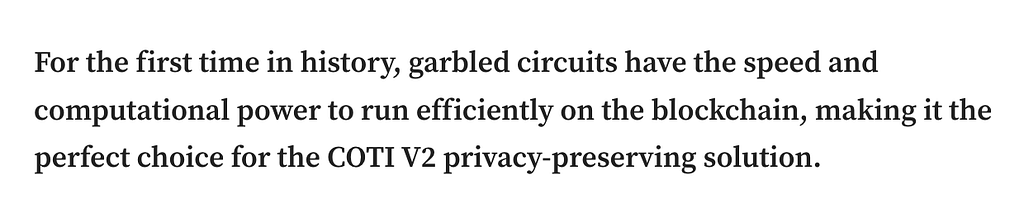
Brad confirmed the timeline: COTI’s privacy layer has been live since April 2025, just a few months shy of a full year in production.
That detail matters because it reframes “privacy” from a promised future into something operational today.
https://medium.com/media/2ab440447df39521b53e63286bfcf43f/href
Privacy Is Not Secrecy
Midway through the discussion, Mark drew what may be the most important distinction in the entire conversation:
Privacy and secrecy are not the same thing.
Tools like Tornado Cash are often treated as privacy benchmarks, but in practice they’re associated with obscuring trails — especially around exploits.
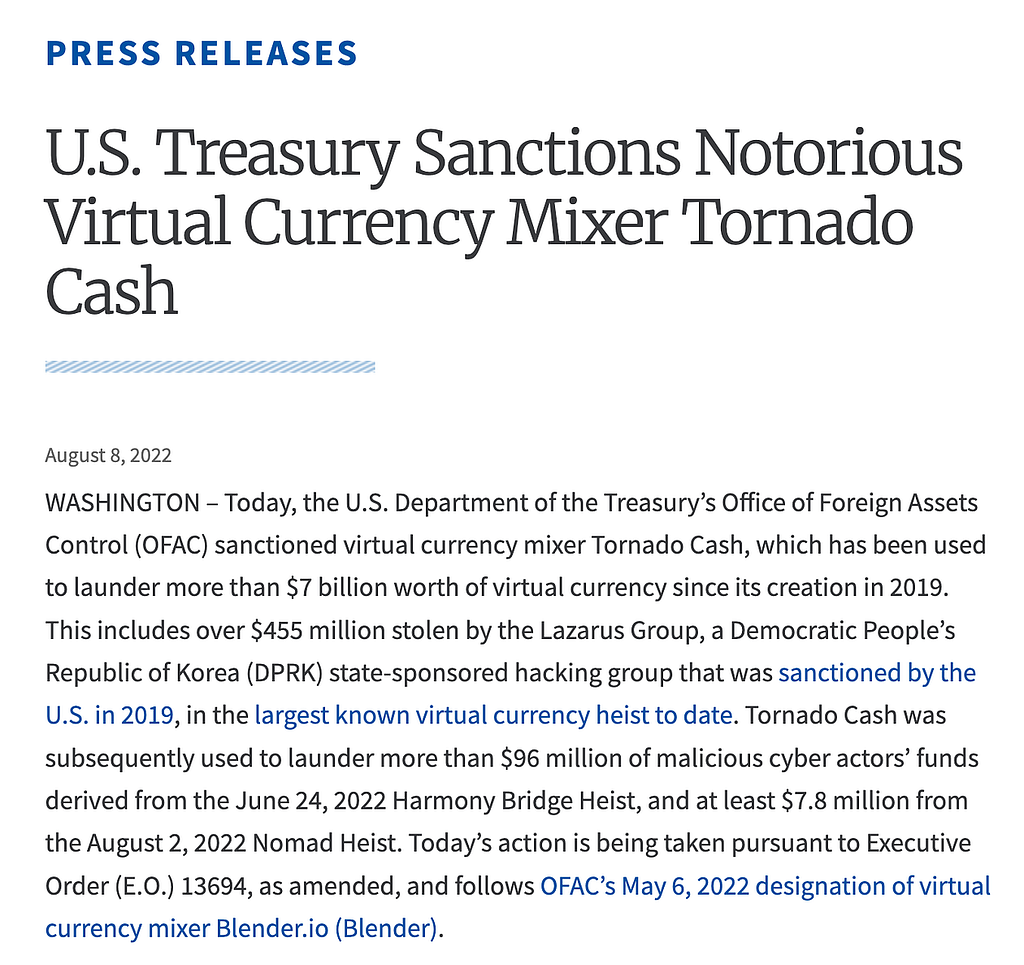
The privacy/secrecy association creates a damaging shortcut:
privacy → secrecy → criminality
Mark argued that framing is backwards.
https://medium.com/media/12a7e4208375051bec302bf47be63e49/href
Privacy can mean protection, discretion, and lawful operation — particularly for institutions that are required to safeguard sensitive activity.
Brad extended the idea practically:
• wallet-to-wallet visibility can still exist
• oversight can still exist
• what doesn’t need to be revealed are granular details: amounts, asset types, sensitive metadata
This is where “programmable privacy” stops being theoretical:
Not no one can see anything — but the right parties can see the right things, when required.
https://medium.com/media/6cf5a179e19c1f1dddcdcdb5f5dc5175/href
Compliance Isn’t a Feature — It’s a Process
As the discussion turned toward evaluation criteria, Mark drew a clear line:
Compliance isn’t a technological problem.
It’s a process.
Regulations evolve. Jurisdictions differ. Policies change. Compliance happens around a system — through engagement with regulators and lawmakers — not inside a single piece of code.
https://medium.com/media/e0252c55e3a8d7c58d9e73bb25c808ec/href
Mark pointed to COTI as a compelling example of how flexibility changes that equation. Not because it “solves” compliance, but because it gives projects room to operate within it.
“COTI is one of, if not the most compelling solution for these things just because of the flexibility of it.”
In the end, flexibility — not maximal transparency or total opacity — is what determines whether compliance is achievable at all.
Why Computational Soundness Matters
As the conversation continued, Mark returned to something he prioritizes: certainty.
ZK proofs are probabilistic by nature — you run computations repeatedly until you’re “certain enough.” Garbled circuits behave differently: run once, deterministic output.
That distinction matters when privacy starts protecting institutional-scale value.
https://medium.com/media/0cace38b3455c6ac4269b2d2847802fc/href
If the margin of error exists, it compounds forever. And when the stakes reach hundreds of billions, tolerance for uncertainty disappears.
Privacy infrastructure can’t just be clever. It has to be computationally sound, defensible, and predictable.
COTI Earn: Live on Carbon DeFi
The discussion extended into COTI’s ecosystem incentives program, COTI Earn, designed to encourage users not just to hold assets on the network, but to actively engage with decentralized applications built on it.
Each season, COTI Earn allocates token points to specific onchain actions — staking COTI, holding assets like gCOTI, USDC, wBTC, or wETH, and most notably, deploying trading strategies on Carbon DeFi, Bancor’s orderbook-style DEX.
https://medium.com/media/769823eef4f1fb627347277ce541db18/href
Users can create full-range liquidity strategies, deploy concentrated liquidity, or build more advanced recurring strategies — all while earning trading fees from market activity and accumulating COTI Earn token points on top.
https://medium.com/media/2c05531eb227ecf96d1d8cb5f198bc88/href
A Clearer Picture
By the end of the call, the picture was clearer — and more grounded — than most privacy debates allow:
• Privacy is rising because adoption demands it
• The goal isn’t secrecy, but selective disclosure
• The most compelling systems will be programmable and composable
• Compliance isn’t a checkbox — privacy must support the process
• Not all privacy technologies are equivalent
Blockchain transparency built trust for early adopters.
Blockchain privacy builds for mass adoption.
For the full recording:
https://medium.com/media/3aa4035afd6161fea8257a8f75fd31b9/href
Blockchain Banter
Blockchain Banter is a live, unscripted discussion series where industry experts, builders, and thought leaders come together to share knowledge, challenge ideas, and explore the evolving landscape of DeFi and blockchain.
🎙️ Follow me on X at x.com/Here2DeFi and tune in weekly on Wednesdays at 3PM UTC.
Presented by Bancor
Bancor has always been at the forefront of DeFi innovation, beginning in 2016 with the invention of the Constant Product Automated Market Maker and “pool tokens” — which still remain extensively used across the industry. The newest inventions powering Carbon DeFi and Arb Fast Lane substantiate Bancor’s deep commitment to delivering excellence, advancing the industry, and pushing the boundaries of what is possible in the world of decentralized finance. For more information, please visit www.bancor.network.
Transparency vs Privacy was originally published in Bancor on Medium, where people are continuing the conversation by highlighting and responding to this story.