What happened in the world of artificial intelligence this week? What new products were introduced? In our “AI Diaries” series, we continue to record weekly updates in this rapidly growing field.
Artificial intelligence technologies, which have recently become much more common in daily life, continue to develop rapidly. While a remarkable development occurs almost every day in this field, significant thresholds are being crossed one by one. In our “AI Diaries“ series, we continue to regularly record the development of this technological revolution, which has the potential to significantly change life on earth in the coming period.
What Happened in the AI World This Week?
While Western companies like OpenAI and Google took important steps this week, perhaps the most striking news came from China. While companies like Tencent and ByteDance released remarkable new AI tools, Xiaomi also made a very ambitious entry into the artificial intelligence space. In parallel with these, as every week, new artificial intelligence tools entered our lives. Here are the highlights of this week in the AI world:
Xiaomi Makes an Ambitious Entry into AI with MiMo-V2-Flash Xiaomi, one of

China’s leading technology companies, had been relatively ineffective in artificial intelligence until now, but things changed suddenly this week. Xiaomi’s open-source model released this week, MiMo-V2-Flash, performed equivalently to, or even better than, powerful competitors like GPT and Gemini in performance tests. Even more impressive is that MiMo-V2-Flash does this much more efficiently. Despite having 309 billion parameters, it has an interesting architecture that uses only 15 billion parameters during processing, putting it ahead of even DeepSeek in terms of the performance and efficiency balance.
Google Launches Gemini 3 Flash

Gemini, which has started to close the gap with ChatGPT as it becomes increasingly popular, gained another new model this week. A month after the introduction of Gemini 3 Pro, Google began rolling out the more efficient Flash version of its new AI model. According to the company, this new model offers professional-level reasoning capabilities similar to the flagship version but is more suitable for daily use thanks to its much lower cost.
In tests, Gemini 3 Flash significantly outperforms Google’s previous generation models, including Gemini 2.5 Pro. More notably, according to Google’s tests, the model achieved results on par with OpenAI’s flagship GPT-5.2 model.
Chinese Researchers Develop Optical Chip 100 Times Faster Than Nvidia GPUs
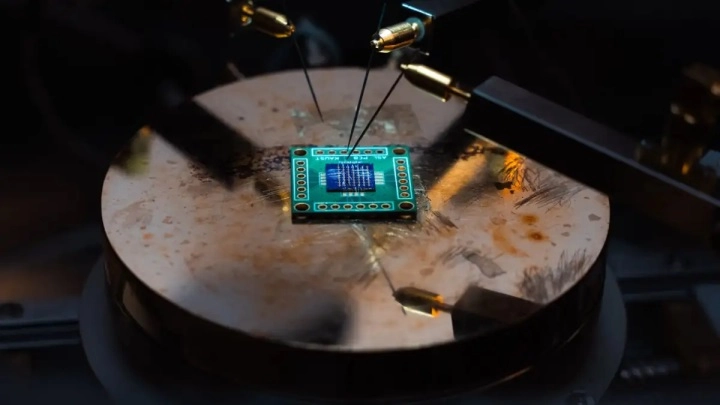
Chinese scientists announced that they have developed a new series of photonic (light-based) microchips that work 100 times faster than some of Nvidia’s most powerful AI GPUs in terms of speed and energy efficiency for certain tasks. It is stated that these chips can easily surpass Nvidia’s current solutions, especially in specific generative AI tasks such as video generation and image synthesis. However, this does not mean that the technology is a direct alternative to Nvidia GPUs. It is noted that the chips are designed for narrow-scope AI workloads rather than general-purpose computing.
These new photonic chips (ACCEL and LightGen) developed in China use photons instead of electrons. Calculations are made through light interference, making them extremely fast and energy-efficient. To use a simple analogy, you can think of Nvidia GPUs as multi-purpose programmable calculators, while photonic chips work like special-purpose analog machines that do a single job exceptionally fast.
ChatGPT Now Has Its Own App Store
OpenAI continues to transform ChatGPT from just a chat tool into a much more comprehensive platform. The company announced the opening of a built-in app directory within ChatGPT and released the Apps SDK in beta so developers can build new applications that run within the bot interface. This move embodies the vision of ChatGPT becoming an “everything app” that can interact directly with different services, from Apple Music to DoorDash. Thanks to the new system, users can discover all applications offered within ChatGPT through a single directory; developers can expand the bot’s capabilities by designing chat-focused experiences.
South Korea to Be the First Country to De Facto Implement AI Regulations

South Korea is preparing to become the first country to effectively implement comprehensive AI regulations by enacting the National AI Framework Act as of January 22, 2026. The new law mandates the establishment of a national AI committee, the preparation of a three-year basic AI strategy plan, and the imposition of both safety and transparency obligations for specific AI systems. The regulation adopts a risk-based approach and introduces much stricter rules for “high-impact” AI systems used in critical areas such as health, education, and public services.
One of the most striking aspects of this new law is the regulation requiring the addition of a mandatory watermark to content produced by artificial intelligence. The South Korean administration aims to prevent deepfake content and disinformation with this practice.
Foundation Aims to Produce 50,000 Robot Soldiers by 2027

Parallel to the explosion in the field of artificial intelligence, significant breakthroughs in robotics have paved the way for humanoid robots, once unique to science fiction, to become reality faster than we expected. Moreover, these robots will not remain only as assistants used in homes and factories. Robot soldier projects have already begun to emerge. The latest example of this is Foundation.
Foundation, a US-based startup, announced that it aims to produce 50,000 combat-ready humanoid robots by the end of 2027. At the center of Foundation’s plans is the humanoid robot named Phantom MK-1. Approximately 1.75 meters tall and weighing 80 kilograms, this robot is designed for reconnaissance, bomb disposal, logistics support, and direct combat scenarios.
New AI Tools Introduced This Week
- Ray3 Modify, developed by LumaLabs, makes it possible to freely play with videos and add various effects. Ray3 Modify might be the most impressive model released to date in this regard.
- Seedance 1.5 Pro, developed by ByteDance (the company behind TikTok), produces impressive work in generating voiced videos.
- ChatGPT’s image generation tool has been renewed. According to the company, the updated ChatGPT Images works four times faster than the previous version. The new version is also more successful in understanding instructions.
- LongVie 2 attracted attention with its ability to produce long videos with a duration of up to 5 minutes.
- HY-World 1.5, developed by Tencent, can create interactive 3D worlds starting from static images.
- SAM Audio, developed by Meta, makes it possible to isolate any sound from complex sound mixes with multimodal inputs. Thanks to this technology, for example, it becomes possible to isolate the sound of a guitar simply by clicking on the guitar in a concert video, or to clean up dog barking in a podcast recording with a simple text command.
Shorts from the AI World
- Seeing the great interest users have in image-generating tools like Nano Banana, Meta took action. The company is developing a new generative AI codenamed Mango.
- OpenAI announced that Apple Music will be integrated into ChatGPT. With the new feature, users will be able to create playlists and access music more easily via ChatGPT.
- OpenAI and Anthropic are implementing new measures to make AI chatbots safer for young users. Both companies are developing age estimation models.
- NotebookLM switched to the Gemini 3 infrastructure with the new update.
- It has been confirmed that negotiations are underway between OpenAI and Amazon for a new investment and strategic cooperation that could exceed $10 billion.
- It was revealed that the VPN extension “Urban VPN Proxy”, usable in Chrome and Microsoft Edge browsers, secretly recorded users’ chats with artificial intelligence.
- YouTube has toughened its stance against those who share videos produced with artificial intelligence; especially those producing content that violates copyrights. Two large channels producing and sharing AI-generated movie trailers were shut down simultaneously.